See what earns the mark.
A photographed answer. The reasoning behind each mark. Feedback a student can act on.
Handwritten work, read in context
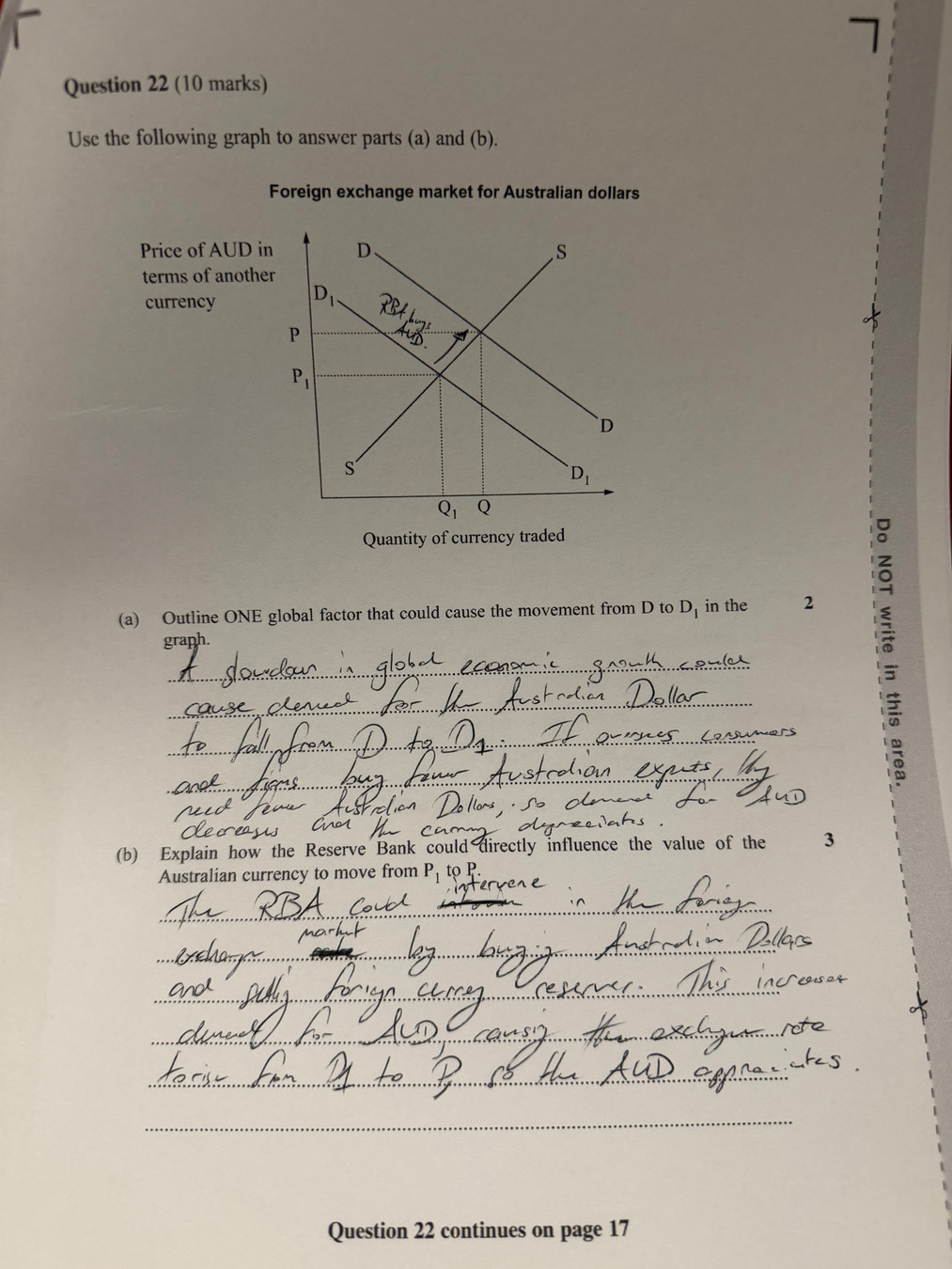
This sample response to Question 22 from the 2025 HSC Economics paper includes a graph, handwriting and crossed-out working. Axtant read the photograph, matched both answers to their question parts and marked them against the guide.
Axtant’s result
Part (a)
You outline one global factor: a slowdown in global economic growth. You explain how this can reduce overseas purchases of Australian exports, decrease demand for Australian dollars and cause the currency to depreciate, meeting the 2-mark band.
Part (b)
You fully explain how the RBA could directly influence the currency: it intervenes by buying Australian dollars and selling foreign currency reserves, increasing demand for the AUD and causing it to appreciate from P₁ to P.
Explore more marking decisions
These practice questions and sample answers show how different criteria change the mark. Each was written for Axtant and marked by the app.
Marking a short economics explanation
A two-mark answer about interest rates shows why naming an outcome is only part of an explanation.
Marking a discuss question in economics
A four-mark response weighs higher pay for low-income workers against the ways businesses may respond.
Marking an economics analysis
Follow a currency depreciation through import prices and household purchasing power.
Marking an economics evaluation response
A short essay evaluates an indirect tax using a supplied six-mark rubric.
Marking an economics graph interpretation
A demand shift example separates reading the graph from explaining the change.
Marking an economics stimulus response
A sample data extract makes it possible to check whether a student uses evidence accurately.
Marking an economics calculation with working
A percentage-change question shows how credit can follow the working when arithmetic goes wrong.
Awarding partial credit in economics
A three-mark answer identifies the relevant policy but stops before the full causal chain.